What Are Tapas? The Real Story Behind The Spanish Food Tradition
There is no food word in Spanish that has traveled further and arrived more distorted at its destination than tapa. It is on menus everywhere now, in London, New York, Singapore. Small plates. Sharing plates. Tapas-style. And that version isn't entirely wrong. It's just missing most of what matters.
I've been eating tapas in Spain since 2010, and I covered the full story in a recent episode of my podcast Spain Explained: the history, the regional differences, the free tapa debate, and the origin legends that food historians tend to roll their eyes at.
But because I get asked about this constantly, and because most of what surfaces online skips the interesting parts, I want to lay it out here properly. What tapas are. How they work. What the history really shows. And why the concept is so hard to export.
What is a tapa, exactly?
The Real Academia Española defines a tapa, in its eighth meaning, as a small portion of food served as an accompaniment to a drink. Technically correct. Also almost useless in practice.
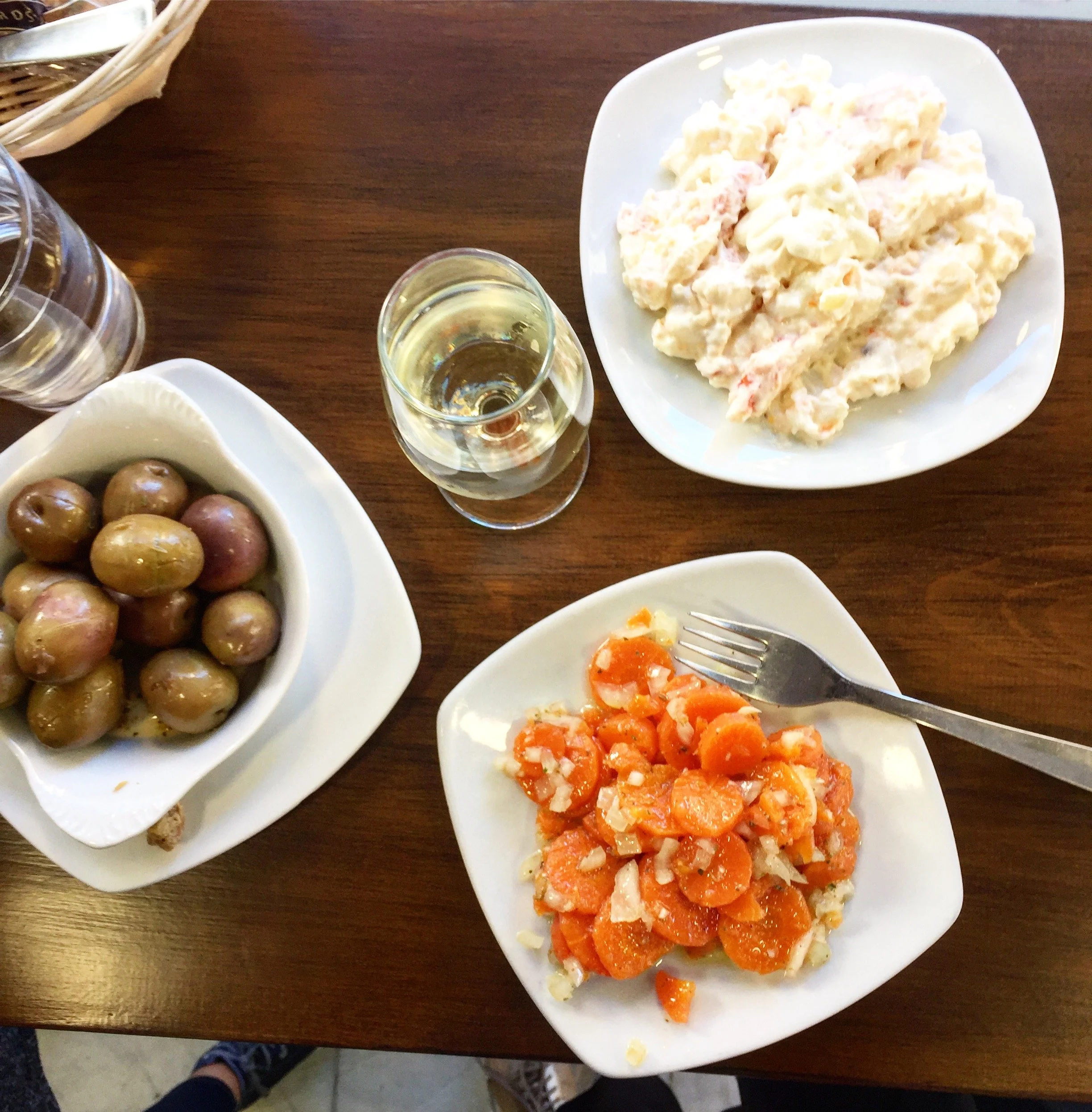
In real use, a tapa can be a few olives. It can be a cazuela of slow-braised tripe. It can be a single anchovy on a slice of bread, or an elaborate composed bite from a trained chef. In some parts of Spain it arrives without you asking, free, the moment you order a drink. In other parts you pay for every bite and choose from a written menu. The same word covers nearly the entire range of what Spaniards eat in bars.
What the definition does get right is the relationship with the drink. A tapa doesn't exist on its own. It is, by nature, an accompaniment, and that relationship is the key to understanding everything else.
Tapas are not really about the food
This is the thing I find myself saying most often, and the thing that most surprises people when I say it. A tapa was never really only about the food. The food is what keeps you at the bar long enough for everything else to happen.
Going out for tapas has its own verb in Spanish: tapear. The full practice of moving from bar to bar has its own noun: el tapeo. There is also el tardeo, a more recent term for going out in the late afternoon, which has become its own subset of tapa culture in cities. Spain has been pushing for formal UNESCO intangible cultural heritage recognition for the tradition, which tells you something about how seriously the country takes it.
Bars in Spain function as social infrastructure in a way that doesn't have a real equivalent in most other places. The bar on the corner is where you run into your neighbors, where local grievances get aired, where you bring your kids on a Sunday morning. The tapa is what keeps you there long enough for all of that to happen. Two or three bars is normal for a weekend pre-lunch outing. At each stop you might have one drink and one or two bites. The food accumulates across stops. It's abundance through variety and movement, not quantity in one place.
When people try to replicate this at a tapas restaurant abroad, they get the food right sometimes. The architecture almost never travels.
Are tapas free in Spain?
This is the question I hear most from people planning a trip to Spain, and the answer is: it depends enormously on where you are.
In parts of Andalucía, particularly in cities like Granada, Almería, Jaén, and Cádiz, tapas have traditionally arrived free with a drink. You order a beer or a glass of wine and something comes with it. In Almería the tradition is particularly generous. Customers can often choose their tapa, and the portions are substantial by any measure.
One of the great Almería specialties is the cherigan: a thin slice of bread cut on the bias, toasted, spread with aioli or tomato, topped with tuna, anchovies, or ham. The name is a Spanish phonetic corruption of "sheriff gun" because the shape is long like a pistol. It was invented at a bar called Parrilla Colón by a cook who went by the nickname El Sheriff, during the 1950s when Almería was in the middle of its spaghetti western boom and the whole city was saturated in American western iconography. The bar eventually closed, but the cherigan spread, and you can still find it across Almería today.
The free tapa tradition is under economic pressure, though, and the conversation around it is live and sometimes heated. The mayor of Granada made headlines by publicly arguing the practice had become financially unsustainable for bars. The mayor of Lugo took the opposite position and encouraged his city's bars to maintain it. Some in the industry argue the model works fine, you just raise the drink price slightly. Others say the math no longer adds up. There is no settled answer.
In the north of Spain, and in cities like Madrid and Barcelona, tapas are generally paid for. You look at what's on the bar or on a board, you order, and you pay. The social logic is the same. The economics are different.
How do you go out for tapas?
You don't make a reservation. You go to a bar. Standing at the bar is the traditional position. You can see what's being served, talk to the person next to you, stay embedded in the current of the place. Order a drink first. Where tapas are free, something will arrive or you'll be asked to choose. Where they're paid, you order from whatever's on offer.
You eat, you drink, you talk. When you're done, you move. That movement is the whole thing.
The most classic moment for tapas in Spain is the pre-lunch aperitivo, roughly between noon and two on weekends, when bars fill up before people sit down to the main meal of the day. But tapas have expanded into dinner territory too, especially on weekend evenings, when a full tapeo across several bars becomes the meal itself.
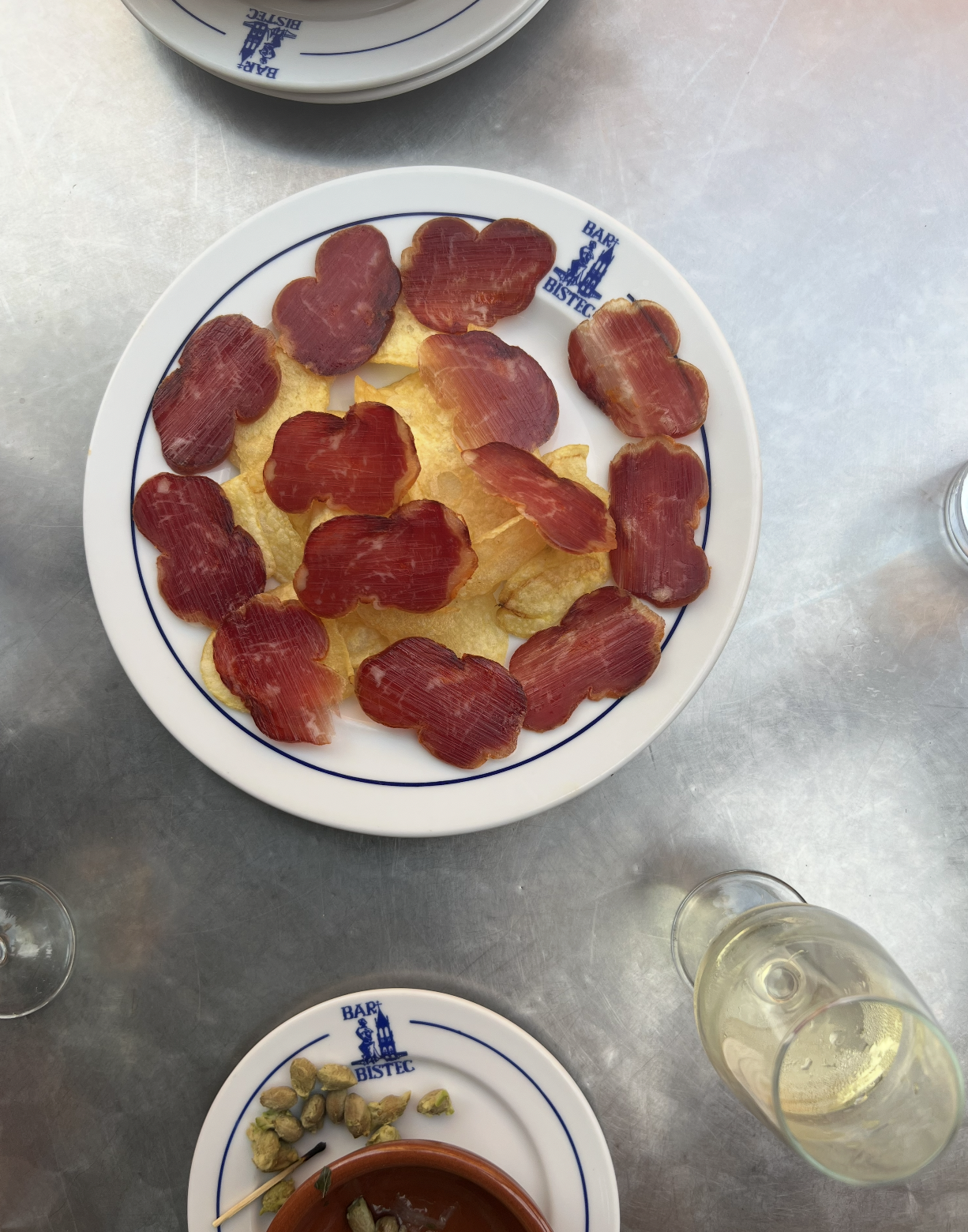
Classic tapas you'll find across most of Spain: tortilla española, croquetas, jamón, patatas bravas, gambas al ajillo, ensaladilla rusa. Regional signatures matter enormously. In Andalucía, pescaíto frito and cazón en adobo. In Galicia, pulpo a la gallega. In Madrid, callos and oreja a la plancha. In Castile, pinchos morunos and morcilla. Part of the pleasure of traveling around Spain is learning what to order where.
Tapas vs. pintxos: what's the difference?
In the Basque Country and Navarra, the concept shifts into something different enough to have its own name: the pintxo. I'm going to give pintxos their own full episode because they deserve the space (and I literally wrote the book), but the short version is this. Pintxos are always paid for, tend to be more elaborately composed, are traditionally eaten standing up before a meal, and are tied to that specific northern geography. Calling them the same thing as tapas is a mistake most Basques will correct you on, firmly and immediately.
The history of tapas: what the evidence shows
Here is where I want to push back a little on the version that tends to get repeated.
The honest answer is that no one knows exactly how the tapa got its name or precisely when the practice began. The food historian Ana Vega Pérez de Arlucea, who has done the most rigorous archival work on this question, draws an important distinction that most popular accounts skip over.
The practice of eating something small alongside a drink is old, probably centuries old. Tavern keepers figured out long ago that a salty or savory bite made customers drink more. But those small accompaniments were not called tapas. The word, as a food term, entered the Royal Academy Spanish dictionary in the 1930s and was initially marked as an Andalusianism. Other parts of Spain had their own names for the same thing: platillo in Cádiz, friolerillas and cositas in other parts of Andalusia, piscolabis elsewhere. Tapa was one regional word that spread. The underlying habit it describes is considerably older than the word itself.
The best documentary evidence for how the word got attached to food comes from a 1904 travel memoir by Nicolás Rivero Muñiz, an Asturian journalist based in Havana who wrote up his impressions of traveling through Spain. He describes stopping at the Venta de Eritaña, a famous bar in Seville, and being served what he calls "chatos con tapaera": small glasses of manzanilla covered with thin, almost transparent slices of Vic salchichón or jamón serrano. He called it the essence of what's delicious and the height of elegance. The cover on the glass, the tapadera, is almost certainly where the word comes from. The cured meat served double duty: practical lid and the entire reason to stay.
Then there are the origin legends. There are at least four of them, all involving Spanish royalty stopping at a southern tavern and someone improvising a jamón cover over a glass of wine. Four different kings, all set in Andalusia, none supported by documentary evidence. When Spain formally submitted its push for tapa culture's cultural heritage recognition, the official documentation included a section called "Origin Legends," treating these stories as part of the record. Ana Vega noted at the time, with some exasperation, that cataloguing myths in an official document is not the same as establishing historical fact. The legends keep circulating anyway. They do reveal how Spain thinks about the tapa: rooted in the south, practical, improvised, hospitable.
Where the tapa is going
The tapa has not stayed static. Ferran Adrià incorporated the concept into elBulli, using small composed bites to structure entire tasting menus. Cooking in miniature with maximum technique packed into a single bite became a serious strand of Spanish cuisine. Every November, the Concurso Nacional de Pinchos y Tapas de Valladolid draws Spain's top chefs to compete for the title of best tapa and best pintxo. If you want to understand where high-end small-plate cooking is heading in Spain, that competition is worth watching.
At the same time, the tapas that matter most to most people are not the ones winning competitions. They're the ones that arrive free in Jaén, the tortilla someone's grandmother makes, the plate of jamón nobody had to order. The tapa exists at both ends of Spanish cuisine at once.
World Tapas Day falls on June 16, though it's a relatively recent creation promoted by Turespaña , not so much a long-established tradition.
Listen to the full episode
All of this is covered in depth in the Spain Explained episode on tapas, including the full regional picture, the free tapa debate, the cherigan story, the royal legends, and what the 1904 Seville memoir says word for word. You can find it wherever you listen to podcasts.
If you want more, sign up for my newsletter!