What Is Catalunya? Spain's Northeastern Region Explained
Catalunya (or Cataluña in Spanish, Catalonia in English) is the northeastern corner of Spain, a region of four provinces and around eight million people with its own language, its own government, and a fifth of the Spanish economy. Barcelona is its capital and one of the most famous cities on earth, and only one Catalan in five lives there. I've lived in Spain since 2010, and Catalunya is probably, I’d say, the region people hear about most and get explained the least, beyond Barcelona, that is.
BTW, this post is the companion to Episode 34 of my podcast, Spain Explained, the first in a series on all seventeen of Spain's autonomous communities (if you’re wondering what those are, I have an episode about it here.). It went out this week because September 11 is the Diada, the national day of Catalunya.
Keep reading today’s blog, where you’ll find all the questions you never knew you had about Cataluña, to help you understand the region, along with a list of ten things to see and do.
Where is Catalunya located?
Catalunya occupies the northeastern corner of Spain. France and Andorra sit on top of it, Aragón lies to the west, and the Valencian region is below. The Pyrenees run along its northern edge and the Mediterranean runs down the eastern side for more than five hundred kilometers, from the rocky Costa Brava near the French border to the Ebro delta in the south, where the river spreads into rice fields. Coming in from France, you cross mountains and then the land steps down to the sea.
Is Catalunya a country or part of Spain?
Catalunya is part of Spain. It is one of Spain's seventeen comunidades autónomas, with its own government, the Generalitat, and its own parliament. Whether it should be an independent country is the question that has dominated its politics for decades, and Catalan society remains divided on it, inside families and inside neighborhoods.
The dated version, sticking to what people voted for: the Generalitat was restored in 1977 after the Franco dictatorship and a Statute of Autonomy followed in 1979. In 2006, Catalans approved an expanded statute by referendum. In 2010, Spain's Constitutional Court struck down parts of it, a ruling that moved many people toward independence. In October 2017, the Catalan government held an independence referendum the courts had suspended; the police response was seen around the world, a unilateral declaration of independence followed, and several leaders went to prison while others left the country. In 2021, the Spanish government pardoned nine jailed leaders, and in 2024 parliament passed an amnesty law covering liability linked to the independence process. In the Catalan elections of May 2024, the parties supporting independence lost their parliamentary majority for the first time since 2015, and the Socialist Salvador Illa became president of the Generalitat.
What is the capital of Catalunya?
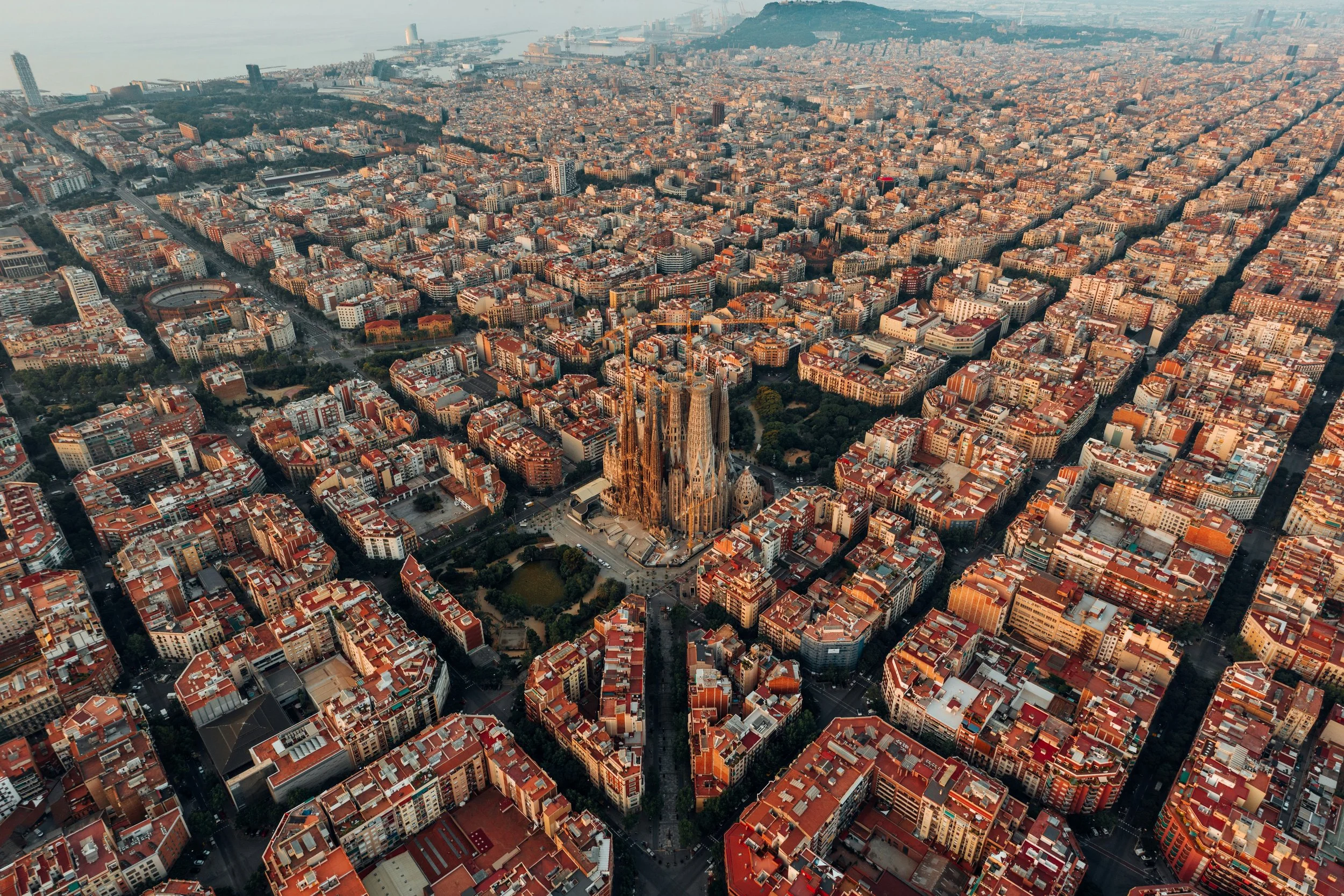
Barcelona. It is the second largest city in Spain, with over 1.7 million people in the city and around five million in the metropolitan area, one of the great ports of the Mediterranean, and the place where the 1992 Olympics turned an industrial waterfront into beaches. The basic city layout: the medieval Barri Gòtic by the port, the Eixample grid of wide avenues and cut-off corners designed by Ildefons Cerdà when the walls came down, and Antoni Gaudí's buildings rising out of that grid. Seven of Gaudí's works are on the UNESCO World Heritage list. The Sagrada Família has been under construction since 1882; its six central towers were completed in 2026 and the basilica is still being built. Barcelona is also one of the main publishing centers of the Spanish-speaking world.
What are the provinces of Catalunya?
Four: Barcelona, Girona, Lleida, and Tarragona. Together they hold about eight million people, roughly sixteen percent of Spain, on around thirty two thousand square kilometers, a little bigger than Belgium. Most Catalans live outside the capital, in Girona, Lleida, Tarragona, Reus, the wine country of the Priorat and the Penedès, the ski towns of the Pyrenees, and down south in the Ebro delta.
What language do they speak in Catalunya?
Three languages are official in Catalunya: Catalan, Spanish, and Aranese.
Catalan is co-official with Spanish across the region. Public schooling runs largely in Catalan, and it's on the street signs, the radio, and the menus. Related forms are spoken down the coast in the Valencian region, where the language is officially called valencià , in the Balearic Islands in varieties like mallorquí, in a strip of southern France, and in Andorra, where Catalan is the official language of the country. Estimates run to more than ten million speakers, more than Danish or Finnish.
Aranese is the third. In the Val d'Aran, a valley on the far side of the Pyrenees, a few thousand people speak this variety of Occitan, and it has official status alongside Catalan and Spanish.
Do they speak Spanish in Catalunya?
Yes. Spanish is co-official everywhere in Catalunya, and a large share of the population grew up speaking it at home. Catalunya industrialized in the nineteenth century, earlier and more extensively than most of Spain, and its factories drew workers for generations from Andalucía, Murcia, and the rest of the south and east. Many Catalan families today have roots elsewhere in the country, and plenty of people learned Catalan through school and public life rather than at the kitchen table.
Is Catalan the same as Spanish?
No. Catalan is a Romance language, from Latin like Spanish and French, but it sits closer to Occitan, the historical language of southern France, than to Castilian Spanish. You can hear it in the vocabulary. Window is ventana in Spanish and finestra in Catalan, right next to the French fenêtre and the Italian finestra.
The written tradition runs deep. The Libre de Sent Soví, a Catalan manuscript whose surviving copy dates from the early fifteenth century, is one of the earliest cooking manuals anywhere in Europe. Around 1520 came the Libre del coch, the first printed cookbook in Catalan, with recipes from Italy, Provence, and the Dalmatian coast.
Catalunya, Cataluña, or Catalonia: which is correct?
All three name the same region. Catalunya is the Catalan spelling, Cataluña the Spanish, Catalonia the English. I keep to the local names, on the podcast and here, which is why you'll see Girona and Lleida rather than any anglicized version. People from Catalunya are Catalans.
Why is September 11 the National Day of Catalunya?
The Diada commemorates a defeat: the fall of Barcelona on September 11, 1714, at the end of the War of the Spanish Succession, after which Catalunya lost its own institutions. It is an official public holiday across the autonomous community. Choosing a defeat as your national day tells you how present history is here.
What is the history of Catalunya?
In the Middle Ages, Barcelona was one of the great centers of the Crown of Aragon, which controlled Valencia, the Balearic Islands, and at various points Sardinia, Naples, and Sicily; Catalan merchants and ships were a major commercial force in the western Mediterranean, so the region's sense of itself as outward-facing goes back centuries before modern Spain.
Then, in the nineteenth century, Catalunya industrialized ahead of the rest of the country: textile mills first, then banks, insurance, publishing, and a large urban working class. That head start compounded, and it's why sixteen percent of Spain's population produces about a fifth of its economy today, running on industry, pharmaceuticals, cars, tech, tourism, and food.
What are Catalans known for?
Ask the rest of Spain and you'll hear the stereotype first: Catalans are tight with money, a joke told from Madrid to Sevilla. Catalans have heard it their whole lives. The version they tell about themselves is more useful. Seny means sound judgment, prudence, not getting carried away, and it's a point of national pride. Its counterweight is rauxa, the sudden fit of impulse or creative madness. And you know what, you can kinda see it….it’s a region of careful bankers and shopkeepers, and also the region that produced Gaudí and one of Spain's anarchist movements.
What is Catalunya famous for?
Hmmm, tough one. A couple images: Human towers, book-and-rose day, a scatological Christmas log, Gaudí, and food.
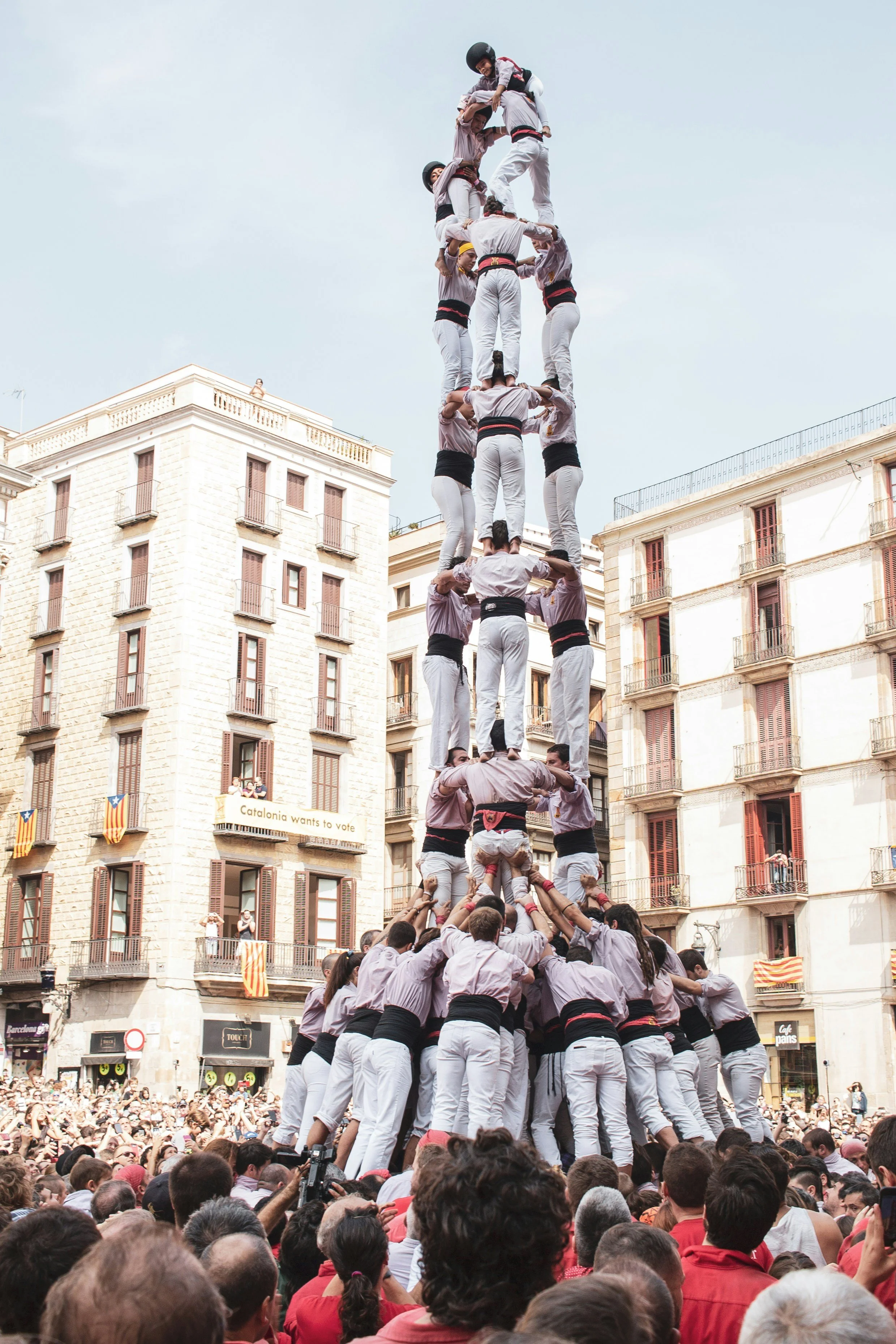
The castells are towers of people built six, eight, even ten levels high by teams called colles castelleres, with a child climbing to the top. The tradition began in the eighteenth century in Valls, in the Camp de Tarragona, and in 2010 UNESCO declared it a Masterpiece of the Oral and Intangible Heritage of Humanity.
On April 23, Sant Jordi, Catalans give each other books and roses and the streets fill with book stalls and flower sellers; UNESCO later chose the same date for World Book Day. On June 23, the eve of Sant Joan, the whole region lights bonfires and fireworks for the solstice. On November 1 it's roasted chestnuts and panellets, little marzipan and pine nut sweets. And at Christmas, children keep a log with a painted face, the caga tió, feed it scraps for weeks, then beat it with sticks while singing until it delivers presents and turrón.
What food is Catalunya famous for?
Pa amb tomàquet, mar i muntanya, calçots, vermouth, and the restaurant that changed fine dining.
The everyday baseline is pa amb tomàquet: bread rubbed with ripe tomato, olive oil, salt. It's on the table at almost every meal and uses up day-old bread. At the other end sits mar i muntanya, sea and mountain, meat and seafood in one pot; the classic is chicken with prawns, where the prawn heads and the chicken fat make a sauce neither could make alone.
Winter belongs to the calçot, a long sweet onion born near Valls about a century ago (I have a recipe on how to make calçots at home, here). From late autumn to Easter, people drive out to farmhouse restaurants for calçotadas, strip off the charred layer, dip the onion in an almond and chile sauce called salvitxada, tip their heads back, and eat it wearing a bib. Here’s my first experience with a calçotada here.
Barcelona's food headquarters is La Boquería on the Rambla, which took over the site of the Convent of Sant Josep after the convent burned in the anti-clerical riots of 1835; construction of the covered market began in 1840. Stalls pass through families for generations.
Catalunya is also the cradle of Spanish vermouth. Reus, in Tarragona province, built an entire industry on it in the nineteenth century, and the ritual of fer el vermut, a vermouth with olives and chips before Sunday lunch, has its deepest roots here even if all of Spain now claims it. I co-founded the vermouth society, so I take this one personally. And El Bulli, Ferran Adrià's restaurant on the Costa Brava, closed since 2011, rewired restaurant cooking worldwide and trained a generation of chefs now running kitchens across Catalunya and far beyond.
10 things to see and do in Catalunya
It’s easy to find a list of what to do in Barcelona…not so much to figure out what the top sights are in Catalunya. Here is my personal list of the best ways to get a real sense of what Catalonia is in its diverse, wonderful glory.
La Boquería when it opens. Be on the Rambla while the fish is still coming off the ice and the city's chefs are shopping the counters. Then walk the Barri Gòtic and the Eixample and let Gaudí's buildings, seven of them on the UNESCO list, do the rest of the day.
A calçotada in Valls, wearing the bib. The calçot and the castells were both born in this one town in the Camp de Tarragona. Season runs late autumn to Easter, and Valls has thrown its Gran Festa de la Calçotada on the last Sunday of January since 1982, with grilling demonstrations, a sauce contest, and a calçot-eating competition. Calçots get their own episode this winter.
Cava at Alta Alella. Fifteen kilometers from the center of Barcelona and two from the sea, inside the Serralada de Marina natural park, the Pujol-Busquets family has farmed organically since 1991, working the local Pansa Blanca grape and making DO Alella wines and cava. The classic visit walks the vines, then the cellar, then pours four wines or cavas. Cava is getting its own episode too, since the DO reaches well beyond Catalunya.
Cadaqués. The whitewashed town at the end of the winding road onto the Cap de Creus is the one Salvador Dalí chose, and his house in Portlligat next door is now a museum. Guía Repsol leads its list of the region's prettiest villages with it.
Calella de Palafrugell and the camí de ronda. Small rocky coves, whitewashed houses, fishing boats hauled up on the sand, and Llafranc and Tamariu next door. The camí de ronda, the old coastal footpath, links all three. Lonely Planet calls them the Costa Brava's most charming low-key resorts.
The Concurs de Castells in Tarragona. The competition runs every two years in the Tarraco Arena, the old bullring, and the thirtieth edition is October 3 and 4, 2026. It's the only castells event with a written rulebook and a scoreboard; the first was held in 1932. Tickets go fast, and the September Santa Tecla festival has towers in the street for free.
Skiing in the Val d'Aran. Baqueira Beret, founded in 1964 and the largest ski resort in Spain, sits at 1,500 to 2,510 meters on the Atlantic side of the Pyrenees, and it’s probably the nicest spot to ski in Spain. The valley is also where Aranese is spoken, so this is the one trip where you can hear all three official languages.
Girona and Besalú. Girona's old town, cathedral steps, and river houses make the base. Half an hour away, Besalú's Romanesque bridge crosses the Fluvià into a medieval core that has kept its shape since the Middle Ages. Both make Guía Repsol's list of seventeen.
Sant Jordi in Barcelona, April 23. If you can pick one day of the year to be in the city, this is it. Open-air bookshop and flower market at once, and the rule is simple: you give a book, you give a rose.
Rice at the Ebro delta, wine in the Priorat on the way. The river spreads into rice fields before it reaches the sea at the southern end of the coast the episode traces. The Priorat's steep vineyards sit inland on the drive down.
Listen to the full episode below, and leave a comment with the region you want next.
This blog started because I was obsessed with Spain. I still am. You can catch more about my life and Spain over at The Spain Dispatch. Sign up for my newsletter where I share what I'm eating, where I'm traveling, and more random stuff! It's free, some come join a few thousand of us! If you liked this post, you'll probably love it.
Key takeaways from the episode
Catalunya is Spain's northeastern region: four provinces, about eight million people, a little bigger than Belgium.
It is part of Spain, with its own government, the Generalitat; the independence parties lost their majority in May 2024.
Three official languages: Catalan, Spanish, and Aranese in the Val d'Aran.
The Diada, September 11, commemorates the fall of Barcelona in 1714.
Sixteen percent of Spain's population produces about a fifth of its economy.
One word: seny. One dish: chicken with prawns. One place: La Boquería at opening.