
What Is the Festival of San Fermín, Really? I've Been Twice, Here's What You Need to Know
I studied abroad in Pamplona. Not in Madrid, not in Barcelona, not like most everyone else. Pamplona, the capital of Navarra, population 200,000, a compact and wonderful city in the foothills of the Pyrenees that most people outside of Spain have heard of for exactly one reason: San Fermín and the running of the bulls.
Pamplona is also one of the most important stops on the Camino Francés, and many visitors first discover the region through a Camino pilgrimage, returning later to explore Navarra's traditions, cuisine and festivals in greater depth.
I lived there for a semester in my early twenties, speaking terrible Spanish and eating incredibly well, and I fell genuinely in love with the place before I ever saw it in July.
I've been to San Fermín twice since then. I cover Spain professionally now, as a food and culture writer, the author of two cookbooks on Basque cuisine, and the host of the podcast Spain Explained, where I recently spent a full episode breaking down the history, rituals, and vocabulary of the fiestas. But my relationship with San Fermín started long before any of that, back when I was a student in Pamplona eating garroticos and reading Hemingway in my apartment and not yet understanding how much of my life I was going to spend in this country. I'm writing this because I want to tell you what the fiestas actually are, from someone who has been there, loves the city, and has thought about this for years.
What Is San Fermín?
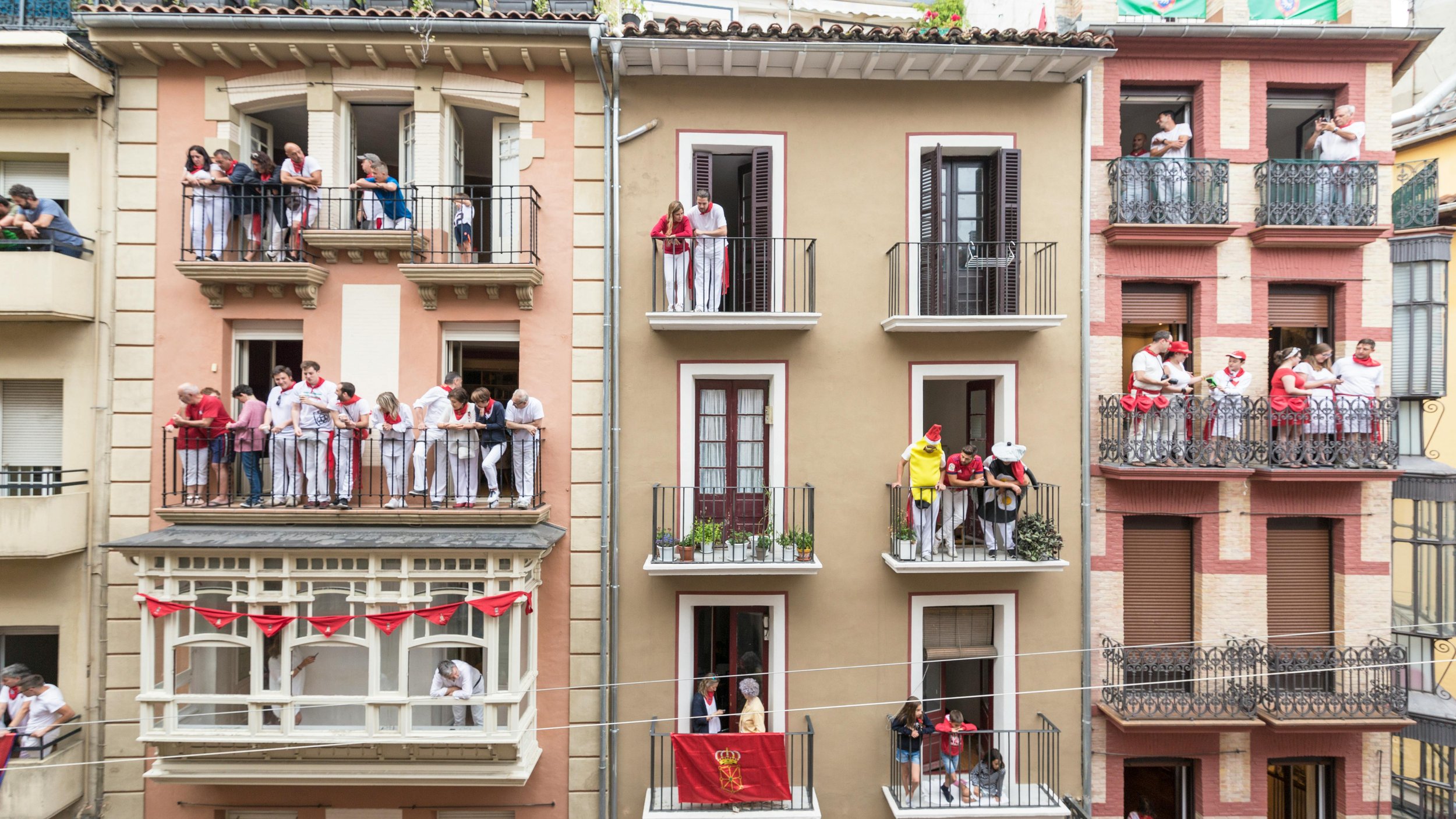
San Fermín, properly called las Fiestas de San Fermín or los Sanfermines (always plural, because yes), runs every year from noon on July 6th to midnight on July 14th. That is just over eight and a half days, or 204 hours as the city of Pamplona likes to count it. The whole event is organized around the feast day of the city's patron saint, San Fermín, a third-century bishop who was born in Pamplona and martyred in Amiens, France. The July celebration has been continuous since 1591.
In 2024, official attendance was 1,842,243 people in a city of 200,000 residents. That’s pretty insane.
The dress code is one of the most recognizable in the world. White pants or skirt, white shirt, a red sash at the waist called a faja, and a red neckerchief called a pañuelo. You tie the pañuelo loosely around your neck from the start. You do not tighten it into a knot until the chupinazo, the opening rocket, fires at noon on July 6th from the city hall balcony. This is a ritual and it is taken seriously. (don’t tie your pañuelo early, you amateur!)
I actually go into this in my podcast, Spain Explained, so please do take a listen if you are curious and want to know more!
What day does san fermín start?
San Fermín in Pamplona, Spain, starts on July 6th and runs to midnight on July 14th.
The Running of the Bulls: What It Actually Is
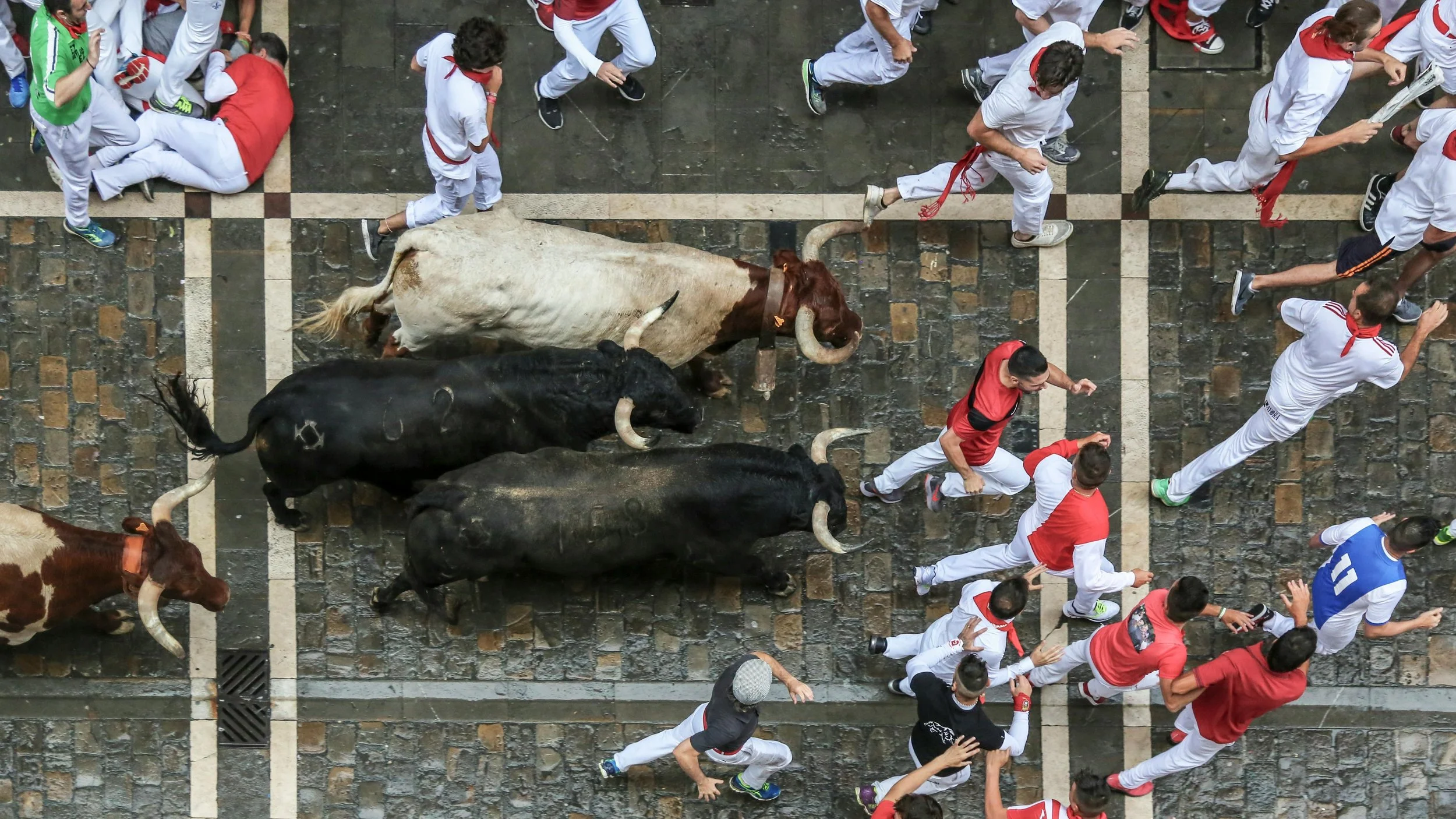
The most famous part of this festival is the running of the bulls. The encierro, as it’s called in Spanish, happens every morning from July 7th through July 14th at eight o'clock. Six fighting bulls and six cabestros, the calm oxen that travel with them and help keep order, are released from the corrals on the Cuesta de Santo Domingo. They run 849 meters through the narrow stone streets of the old city to the bullring. The run usually lasts between two and three minutes, though it can be shorter or longer depending on how the herd behaves. The bulls can reach about 25 kilometers per hour.
The route goes up the Cuesta de Santo Domingo, through the Plaza del Ayuntamiento, along Mercaderes, then the long straight stretch of Calle Estafeta, and through the Telefónica section into the bullring. The corner where Mercaderes meets Estafeta is where the great photographs happen.
Before the run, at five, three, and one minute before the start, runners sing a prayer to San Fermín at a small shrine on the Cuesta de Santo Domingo. In Spanish: "A San Fermín pedimos, por ser nuestro patrón, nos guíe en el encierro dándonos su bendición." In Basque as well. This is not just performance art….fifteen people have died in the encierro since official records began in 1924. Injuries happen every year. The prayer is real.
The bulls that run in the morning are the same bulls that fight in the bullring that afternoon.
I Went Twice, and the Two Times Were Completely Different
The first time I went to San Fermín, I went properly. Which is to say I did not sleep. I have pictures as evidence in this super old blog post of the fiesta. We went in the evening on July 6th, after the chupinazo, and we did not leave until the morning of July 7th, when we watched the encierro from the barricades on Estafeta, totally exhausted, sun coming up, the streets still smelling like the night. I have never been more awake in my life than in the twenty seconds it took six bulls to pass me at full speed six feet away. There is no adequate way to describe it. Masses of people, of course, but so cool..
The second time, I went in the morning. Slept the night before, so arrived fresh as a daisy. We toted a bottle of red wine, a nice one my bff had brought, and made friends with a bartender over coffee. He stored our wine for us while we went to the bullfight in the Plaza de Toros. What I can tell you is that the corrida at the Plaza de Toros de Pamplona during Sanfermines is one of the most serious bullfights in Spain's calendar, and sitting in that bullring and understanding what you are watching, really watching, rather than looking away or treating it as spectacle, is its own kind of education.
The two visits gave me completely different versions of the same event. Both were true.
WHO WAS SAN FERMÍN?
San Fermín himself was born in Roman Pamplona, Pompaelo as it was called, in the third century. He was converted to Christianity, became the first bishop of Amiens, and was martyred there. His feast day was originally celebrated on October 10th. For centuries, Pamploneses honored their patron in autumn, when the Frankish population that had settled in the city's Burgo de San Cernin in the eleventh century observed the date of his entry into Amiens.
The History of San Fermín (Which Is Much Older and More Interesting Than the Bulls)
In 1590, the city council asked the bishop to move the celebration to July, when the weather was better and it could coincide with an existing commercial fair, a feria franca established by King Carlos II of Navarra back in 1381. The bishop agreed. From 1591 on, the celebration moved to July 7th.
The bulls were already part of the fair culture. Bullfights are documented in Pamplona as early as the fourteenth century. The encierro grew from the practical need to move fighting bulls from their overnight pens to the bullring. Shepherds and cattle workers ran alongside them. At some point in the late nineteenth century, people started running in front. That shift changed the whole thing.
In 1689, the fiestas were nearly canceled. Spain was in official mourning for María Luisa de Orleans, the wife of King Carlos II, and the city council felt they could not spend money on bulls and dancing. They redirected the budget into an eight-day religious commemoration, an Octava, with a sung mass each day and sermons on the first and last days. That decision, born from grief and a creatively redirected party fund, is still observed today. Eight hundred years of history, and a 1689 accounting compromise is still on the calendar.
Hemingway and San Fermín
This is the part I cannot be neutral about because I love the book too much to pretend otherwise.
Ernest Hemingway first came to Pamplona in 1923, twenty-four years old, with his first wife Hadley Richardson. He came back many times, his last visit in 1959. He was devoted to bullfighting and never missed a corrida. In 1926 he published The Sun Also Rises, known in Spain simply as Fiesta, and that book turned a regional Navarrese celebration into one of the most visited events on the planet.
One novel, published by a writer who had been to Pamplona twice, changed everything. Pamplona is still living inside that book a hundred years later.
The fictional death of Vicente Girones in the novel, a farmer from near Tafalla, 28 years old, wife and two children, was likely inspired by the real death of Esteban Domeño in 1924, the first officially recorded fatality in the encierro. Hemingway took real grief and put it into fiction, and in doing so made the stakes of the whole thing legible to readers who had never been near a bull.
His monument stands in Pamplona, near the bullring. His name is on a street. When I was a student there I walked past it constantly without fully registering it. Now I think about it differently.
What Most People Miss About San Fermín
The religious procession on July 7th is one of the most important events of the entire fiesta and almost nobody who comes from outside covers it seriously. It begins at the Cathedral, where the city council in formal dress meets the cathedral chapter. They walk together through the old city to the church of San Lorenzo, where the chapel of San Fermín holds a reliquary statue of the saint containing actual relics. The procession then carries that image through the three historic quarters of Pamplona, the Burgo, the Población, and the Navarrería.
Pamploneses have a word for the most emotionally significant moments of the fiesta: los momenticos. The little moments. The transfer of the saint's statue from its altar to the processional litter is one of them. The jota sung at the Plaza del Concejo is another. These are the things locals talk about when they talk about what San Fermín actually means to them, and they have almost nothing to do with what the international press covers.
The first relic of San Fermín arrived in Pamplona in 1186. That is how long this city has been devoted to its patron.
The fiesta closes at midnight on July 14th with a song called Pobre de Mí, poor me, sung in the main plaza while everyone holds their red pañuelos above their heads and slowly lowers them. Grown adults weep. People who have been awake for nine days weeping into their red scarves. That is San Fermín, the part nobody warns you about.
Essential Vocabulary Before You Go
Sanfermines: always plural, the fiestas themselves.
El encierro: the running of the bulls, literally the enclosing.
El chupinazo: the opening rocket.
La faja: the red sash at the waist.
El pañuelo: the red neckerchief.
Los momenticos: the little emotional moments locals hold most dear.
Los gigantes: the eight enormous processional figures representing the four continents, made by sculptor Tadeo Amorena in 1860.
Los cabestros: the calm oxen that travel with the fighting bulls.
Las peñas: the neighborhood social clubs that are the true backbone of the fiesta. Being invited into a peña's activities as an outsider is a genuine privilege.
Pobre de Mí: the closing song. The party is over.
How to Watch the Encierro Safely
The encierro is free to watch from the wooden barricades along the route. You can also watch from private balconies, expensive but worth it, or from inside the bullring itself. If you want to run: be sober, know the route beforehand, never touch or grab a bull, and if you fall, stay down and do not move until the herd has passed. Drunken runners are a genuine source of frustration for Pamploneses and for the people who take the run seriously.
I covered all of this in depth in the Spain Explained episode on San Fermín, including the full history, the vocabulary, the Hemingway connection, and what the fiestas feel like from the inside. You can find it on Spotify, Apple Podcasts, and wherever you listen. If San Fermín has been on your mind, or if you just want to understand what you're looking at when the photographs come flooding across your feed every July, the episode is a good place to start.
Eight hundred years of devotion, one American novel, nine days of extraordinary noise. Tie your pañuelo at the right moment. Learn the prayer on the Cuesta de Santo Domingo. Watch the procession. Pay attention to the momenticos.
That is how you actually experience San Fermín. Want more? Check out my podcast on the topic!
Marti Buckley is a food and culture writer based in San Sebastián, the author of Basque Country and The Book of Pintxos, and the host of Spain Explained.
If you want more about Spain: Subscribe to Marti's Substack at https://substack.com/@martibuckley Follow her on Instagram @martibuckley .