
The Ultimate Guide to Gazpacho: History, Authentic Recipe, and Everything You Need to Know
Gazpacho is a cold Spanish soup made from raw blended vegetables, extra virgin olive oil, vinegar, and salt. That is the short answer, the one that satisfies a search query. The longer answer involves centuries of history, a Virginia woman who had never been to Europe, aristocrats eating peasant food out of fine porcelain, and an ongoing argument about cucumber that shows absolutely no sign of resolution. I have been living in Spain since 2010, I have written two cookbooks on Spanish and Basque food, and I still think about gazpacho differently every summer depending on the tomatoes. This guide covers everything: what gazpacho is, how it varies across Spain, its history, how to make a proper one, and the mistakes that produce a version that tastes like nothing.
It’s also based on my Spain Explained podcast episode on the subject:
What is gazpacho?
Gazpacho is a cold soup originating in Andalucía, the southernmost region of Spain. At its core it is raw vegetables blended with extra virgin olive oil, sherry vinegar, and salt, served cold. The most recognizable version, gazpacho andaluz, combines tomatoes, green pepper, cucumber, and garlic. It is consumed across Spain in summer and is particularly embedded in daily life in the south, where in many households it is sipped across the day almost like a beverage. In Seville in July, where temperatures hit 45 degrees Celsius, it functions as a hydration strategy that also happens to be delicious.
Types of gazpacho in Spain
Gazpacho is not one dish. Understanding the variations is useful both for cooking and for ordering correctly when you are in Spain.
Gazpacho andaluz is the classic, the one this guide focuses on. Tomatoes, pepper, cucumber, garlic, sherry vinegar, olive oil. Blended smooth, served cold in a glass or bowl.
Salmorejo is from Córdoba and is thicker and richer than gazpacho andaluz. It always contains bread, which is blended in from the start and gives it a dense, almost creamy texture. It is served in a bowl, topped with diced jamón serrano and hard boiled egg. It is not a variation of gazpacho so much as a close relative with its own rules.
Ajo blanco is from Málaga and contains no tomatoes at all. It is made with blanched almonds, stale bread, garlic, olive oil, vinegar, and cold water, and is typically garnished with grapes or melon. It is one of the most underrated things Spain produces and almost nobody outside the country knows it exists.
Gazpacho manchego is a completely different dish that happens to share a name. It is a warm stew from La Mancha made with game, flatbread, olive oil, garlic, and whatever was available in the field. It is what Sancho Panza was eating in Don Quixote. More on that shortly.
The history of gazpacho: it was not always red
This is the part most people outside Spain have never heard, and it changes how you think about the dish.
Tomatoes arrived in Spain from the Americas in the 16th century but were not immediately incorporated into everyday cooking. The gazpacho that existed for centuries before that was a bread-based preparation: stale bread soaked in water and beaten in a mortar with garlic, vinegar, olive oil, and salt. No tomato. No red color. And because it was associated with field workers and rural laborers, elite culinary literature mostly ignored it. Nobody thought it worth writing down.
When Cervantes published Don Quixote in 1615, Sancho Panza declared: "más quiero hartarme de gazpachos que estar sujeto a la miseria de un médico impertinente." I would rather fill myself with gazpacho than suffer a meddling doctor. The spirit of that line is eternal and completely relatable. But the gazpacho he was talking about was gazpacho manchego, the warm La Mancha shepherd's version, which has almost nothing in common with the cold red soup we know today.
Food historian Ana Vega, who writes as Biscayenne and whose research I draw on in the podcast episode, has documented how messy the written record is. A recognizable recipe finally appears in a 1747 pastry manual by Juan de la Mata, but it describes something called capón de galera, a bread and anchovy preparation eaten on ships because the ingredients did not spoil. Pre-tomato, bread-based, nearly unrecognizable as gazpacho.
The tomato enters the picture slowly and regionally. The first region where it appears in surviving written gazpacho recipes is actually Extremadura, not Andalusia. And one of the earliest recognizable written recipes for the tomato version we know today was published not in Spain but in Washington D.C., in 1824, by a woman from Virginia named Mary Randolph who had never been to Europe. She was related to Thomas Jefferson and had a sister whose husband was the American consul in Sanlúcar de Barrameda, the sherry town at the mouth of the Guadalquivir. The two women almost certainly exchanged letters and recipes. On page 107 of one of the earliest American cookbooks ever printed: "Gaspacho: Spanish." Tomatoes, cucumber, recognizable. From Virginia.
Gazpacho only entered serious Spanish culinary literature after it became fashionable among the Madrid upper classes in the 1880s. Aristocratic households started hosting gazpacho gatherings with fine porcelain while journalists organized satirical competitions with prizes including a gold tie pin shaped like a cucumber and cufflinks shaped like green peppers. That wave of fashionable absurdity is what finally got the recipe taken seriously in cookbooks. By 1892 it appeared in a major Spanish culinary dictionary in a form close to what we make today.
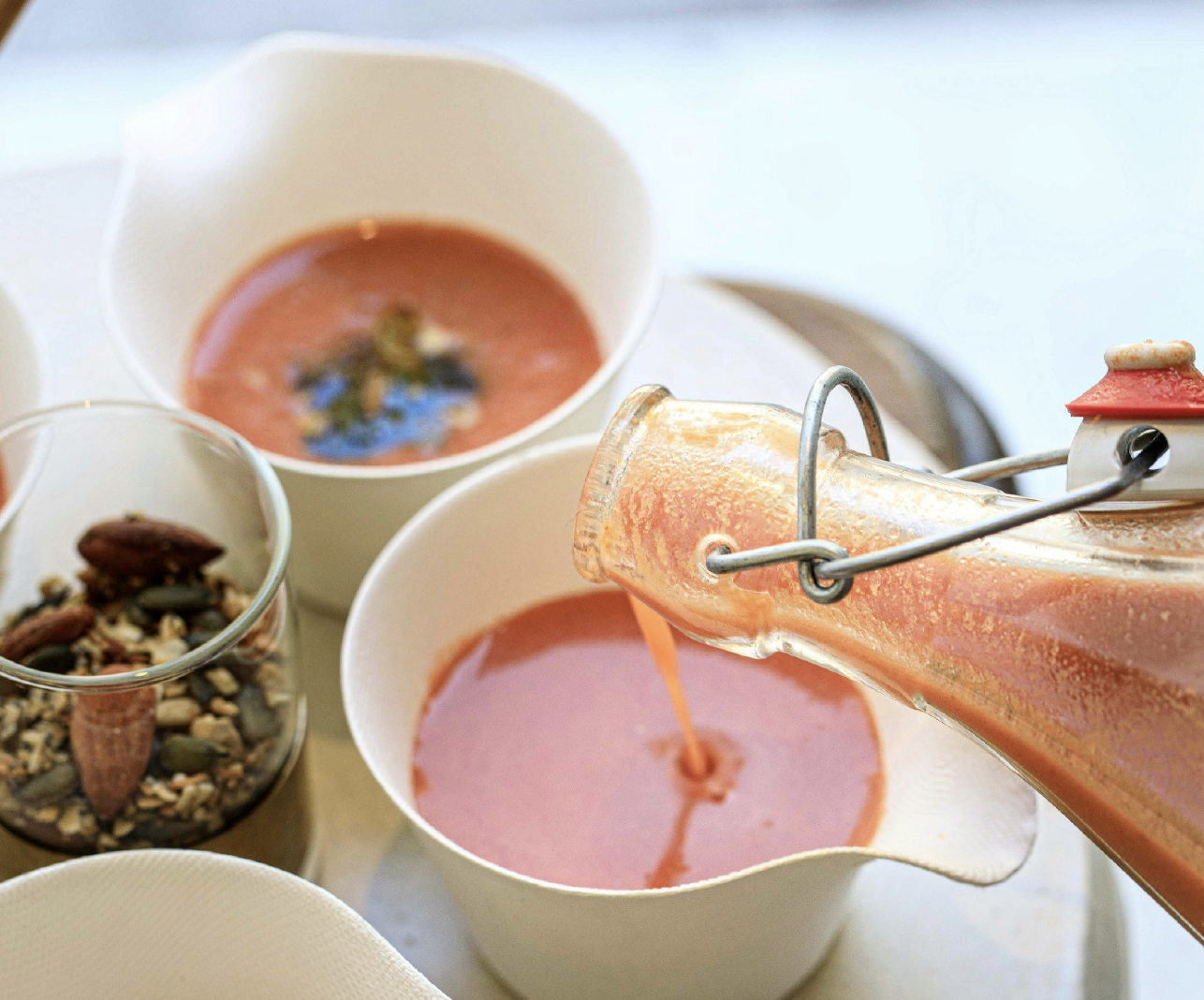
Authentic gazpacho recipe
This is a classic, clean gazpacho andaluz. The recipe is from El Comidista, one of the most respected food outlets in Spain. I have not yet had the time to do what I do for my cookbooks, which is make a dish thirty or forty times until I am fully satisfied with every variable and ready to put my name on it definitively. This recipe is purportedly the recipe behind one of Spain’s most popular commercial gazpachos, so there you go!
Serves 4
1 to 1.2 kg very ripe tomatoes
1 small cucumber, or half a large one
½ clove garlic
1 small piece green pepper
3 to 4 tablespoons sherry vinegar
Extra virgin olive oil Salt
Instructions
Remove the stems from the tomatoes with a knife.
Deseed them by breaking them with your hands over a bowl with a colander set on top so the seeds fall through. Scrape them with a spoon to release all the liquid and surrounding pulp. Discard the seeds and combine the captured liquid with the tomato flesh. Do not discard this liquid. It carries a significant amount of flavor.
Peel the cucumber and chop into large pieces. Add to the tomatoes along with the garlic, green pepper, sherry vinegar, a generous pour of olive oil, and salt.
If you have time, rest the mixture in the fridge for a few hours or overnight. This step is optional but produces a noticeably deeper flavor.
Blend thoroughly until fully combined. Without stopping the blender, add approximately 100ml of olive oil slowly and steadily so it emulsifies into the soup and gives it body and texture.
For a very smooth result, pass through a fine strainer to remove tomato skins. Refrigerate until genuinely cold.
Taste and adjust with more vinegar, salt, or olive oil before serving. Give it a brief final blend. Serve with a drizzle of olive oil and, if eating with a spoon, diced tomato, cucumber, and pepper on top with toasted bread.
How to make gazpacho: technique that actually matters
The olive oil is structural. Essential. This is the most important thing to understand about gazpacho technique and the most common place people go wrong. You add the oil slowly while the blender is running so it emulsifies into the soup. That emulsification is what gives a good gazpacho its slight body and the texture that coats your palate. Adding oil at the end produces something flat. Add it gradually, keep the blender running, feel the difference.
Sherry vinegar is worth seeking out over a standard wine vinegar. It has a depth and roundness that suits this preparation particularly well. I started keeping it in my kitchen when I first moved to Spain and have not been without it since.
Chill it properly. Not slightly cool. Genuinely cold. Gazpacho served at the wrong temperature is a different and worse experience.
Adjust at the end. Taste it after it has chilled and correct the seasoning. The balance of acid, salt, and oil often needs a small correction once cold.
Why does gazpacho taste better in Spain?
Hehe, while that isn’t always true, you can say it’s mostly the tomatoes. In summer in Andalucía, tomatoes are deeply red, soft to the touch, and fragrant in a way that is hard to replicate in other climates. I live in the Basque Country, where the summer is shorter, and even here there is a window when the local tomatoes are extraordinary and everything made with them is better. Although I do have to say nothing beats good heritage Alabama tomatoes. If your tomatoes are not genuinely ripe, wait. Gazpacho made with mediocre tomatoes tastes like mediocre tomatoes regardless of everything else you do. There is no workaround.
The olive oil matters for the same reason it matters in everything: you are not cooking anything, you are serving raw ingredients cold, and quality is immediately apparent.
Common gazpacho mistakes
Using underripe tomatoes. Already covered, worth repeating. This is the one you cannot recover from.
Adding the olive oil incorrectly. Pour it in slowly while blending, not before or after.
Not chilling it long enough. It needs to be cold, not room temperature with an ice cube dropped in at the end.
Over-garlicking. Raw garlic is powerful and will dominate everything else if you are heavy-handed.
Skipping the rest time. If you blend immediately after assembling, you get a fine gazpacho. If you let it sit overnight first, you get a noticeably better one.
Does gazpacho have cucumber?
The Real Academia Española's definition lists tomato, pepper, oil, vinegar, garlic, and salt as core ingredients. No cucumber. This is a reference point, not a binding verdict, as the RAE is most definitely not known for its thoroughness in culinary definition. Real kitchens across Andalucía are considerably more varied than any dictionary entry. Cucumber adds freshness and a slight bitterness that balances the sweetness of ripe tomatoes. Whether you include it is a personal decision that Spaniards have been arguing about for decades and will continue to argue about indefinitely.
Does authentic gazpacho have bread?
In salmorejo, yes, always. In gazpacho andaluz, it depends. Bread adds body and is useful when your tomatoes need help or when you want something more substantial. If your tomatoes are excellent, you may not need it. Traditional versions vary by region and household.
Gazpacho vs salmorejo: what is the difference?
Gazpacho andaluz is lighter and more liquid, often drunk from a glass. Salmorejo is thick enough to eat with a spoon, always contains bread blended in, and is served with jamón and hard boiled egg on top. The tomato-to-bread ratio and the garnish are the main differences. They are related but distinct dishes with different textures and different traditions behind them. You can see a video of me making salmorejo here.
How long does gazpacho last in the fridge?
Three to four days covered in the fridge. Give it a stir or a brief blend before serving as the oil and liquid will separate. It often tastes better on day two than it did on day one.
Can you freeze gazpacho?
Technically yes, but the texture suffers after freezing and thawing because of the emulsification. Better to make it fresh. It comes together quickly enough that freezing is rarely worth it.
Why Spaniards drink gazpacho all day
In Andalucía especially, gazpacho is not reserved for mealtimes. Keeping a pitcher cold and pouring a glass whenever is a normal part of summer daily life. In parts of Jaén, some households traditionally serve it at the end of a meal as a palate refresher rather than as a starter. The heat in the south of Spain is not a minor seasonal inconvenience but a governing fact of daily life from June through September, and gazpacho is part of how people move through it.
The biggest gazpacho myth
That it is a recent or modern dish. Gazpacho in various forms has been part of Spanish food culture for centuries. The cold red tomato version is relatively recent in the long arc of the dish's history, but the underlying idea of a mortar-beaten preparation of bread, vinegar, oil, and garlic has roots in ancient Mediterranean cooking. Roman soldiers carried vinegar and water as a cooling drink on campaign. The technique is old. The tomato is the newcomer.
For the full history including the Virginia cookbook story, the 1880s Madrid trend cycle, the Don Quixote connection, and more on regional variation and technique, the podcast episode is below.
Spain Explained is hosted by Marti Buckley, author of Basque Country and The Book of Pintxos, journalist, and resident since 2010 of Spain. Subscribe to Marti's Substack at https://substack.com/@martibuckley, follow her on Instagram @martibuckley, and find more at travelcookeat.com.